






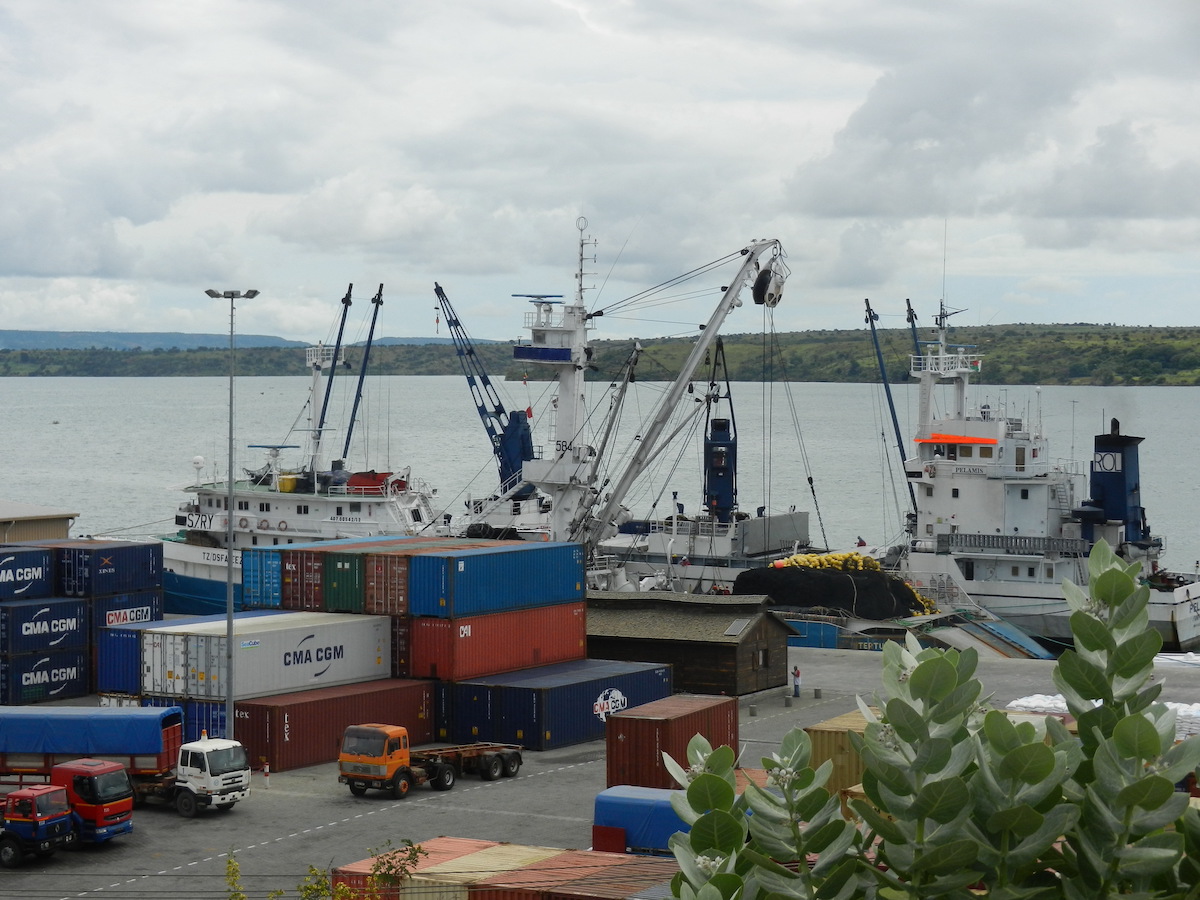
The rise in Russian influence in the Big Island continues. Moscow is reportedly eyeing the SECREN shipyard in Diego Suarez. A logistics foothold of primary importance in the Indian Ocean. Such an acquisition would give Russia a strategic advantage in the Mozambique Channel region: an area at the centre of fierce competition for influence between powers.
At the end of April 2026, a Russian delegation visited SECREN, in the presence of several high-ranking Malagasy officials, including the Minister of Foreign Affairs and the Minister of Industrialisation. Officially, the aim was to explore partnership opportunities for the revival -and modernisation- of the shipyard and to assess the condition of the facilities. In concrete terms, the delegation examined the key infrastructure of the site, including the dry dock, mechanical workshops, port equipment and spaces likely to be integrated into the “2030 Recovery Plan” led by the government.
The significance of this visit lies in the very nature of SECREN. Heir to the former French naval arsenal of Diego-Suarez, transferred to Malagasy authorities after the French military withdrawal in 1973 and then transformed into SECREN in 1975, the company retains undeniable logistical value in this part of the Indian Ocean. Its shipyard and dry dock have long enabled the repair of vessels along a maritime route linking southern Africa, the Middle East and Asia. At a time when the Mozambique Channel is once again becoming a diversion and security route for flows bypassing crisis zones, controlling such an asset amounts to positioning oneself in direct contact with regional maritime traffic.
This opening to Moscow does not erase another factor, more uncomfortable for Paris: France remains in the running for the modernisation of the port of Diego-Suarez and is closely monitoring the future of the Antsiranana facilities, given its own presence in the south-west Indian Ocean and the importance of the Scattered Islands in the Mozambique Channel. The Russian visit to SECREN is therefore not merely an industrial matter; it is already part of a competition for access, influence and logistical pre-positioning.
The coup as an accelerator of Russian anchoring
This shift can only be understood in light of the transition opened by the coup d’état of October 2025. Since Colonel Randrianirina came to power, the rapprochement with Moscow has accelerated at a sustained pace. Delivery of Russian military equipment in April 2026, training provided by Africa Corps instructors to the Ivato parachute battalion, among other duties responsible for presidential security, high-level bilateral meetings in Moscow in February and a multiplication of exchanges in the police and security fields. This dynamic extends an older foundation, with the military cooperation protocol signed in 2018, but gives it a very different political and operational depth.
The rapprochement does not stop at the barracks. Moscow has also invested in the economic and institutional sphere, with the official inauguration of a Russia–Madagascar Chamber of Commerce at the Russian embassy in Ivandry, intended to facilitate investment, particularly in the agricultural, energy and mining sectors. The whole forms a classic pattern of Russian projection in Africa: security assistance, supply of equipment, training, followed by the search for economic relays and logistical access. Madagascar is therefore not an exception, but the insular adaptation of a method already tested elsewhere on the continent.
The African precedent nevertheless calls for caution. In several countries, the Russian arrival has attached itself to moments of political rupture, promising sovereignty, security and diplomatic diversification, before producing security dependence, resource capture and tightening of the internal political game. Yet the Malagasy junta is already facing growing contestation from part of civil society, while its “all directions” diplomacy gives the impression of a headlong rush rather than a stabilised doctrine. The risk is well known: as a weakened regime becomes isolated, the temptation grows to rely on an external protector capable of providing weapons, training and, if necessary, an unofficial praetorian guard. This diplomatic posture contrasts clearly with that of former president Rajoelina, who sought more to balance the country’s external relations than to place it in a situation of dependence.
A Mozambique Channel of critical geostrategic interest
If Moscow is interested in Madagascar, it is not out of geopolitical romanticism. The Mozambique Channel has once again become an area of primary importance because it now concentrates several major vulnerabilities: energy security, diversion of Gulf maritime routes, port competition, illicit trafficking and issues linked to offshore resources (hydrocarbons, mineral resources, fisheries, etc). This axis, through which a significant share of oil and gas flows between the Middle East, southern Africa, Europe and the Americas transits, is also a substitute or complementary corridor, particularly since the attacks in the Bab el-Mandeb Strait (Red Sea). Some shipowners are reportedly even considering making this route permanent, wary of the deterioration of the geopolitical climate in the Gulf.
Mechanically, power dynamics are intensifying. France has military and territorial assets there; India, China, the Gulf countries and several global operators are interested in ports, corridors and resources, including Madagascar’s significant mineral deposits; coastal states, for their part, are seeking to capture more value through the modernisation of their infrastructure. In this equation, Diego-Suarez occupies a singular position: located at the northern entrance of the channel, endowed with a deep natural harbour and an old port and naval heritage, the site can become both a maintenance tool, a point of presence and a lever of influence over regional logistical competition.
This is why the Russian push particularly worries France as well as other regional actors. It is probably no coincidence that the Comoros are attempting to keep Russian diplomacy at a distance, known for its crisis-generating nature. Beyond Madagascar, Moscow is multiplying hostile postures towards Paris in the western Indian Ocean, including on sensitive issues concerning Mayotte and Réunion, where influence operations and anti-French positions are already fuelling tensions. If this rivalry is compounded by a hardening of the domestic political situation on the Big Island, with Russia actively supporting a contested power, the risk would no longer be confined to the Malagasy theatre alone. It would affect the stability of a key state in the Mozambique Channel, and therefore the whole of an area where ports, trade routes, maritime security and political balances are now closely interconnected.